Solutions for gas traceability monitoring through underway surveys in chemical industrial parks
2026-03-06 17:40:44
The OSEN airborne gas traceability monitoring system is a highly integrated mobile monitoring device with functions such as "real-time monitoring, positioning tracking, data transmission, on-site warning, and intelligent analysis". It can achieve dynamic and continuous monitoring coverage of gas pollutants in the target area. The system integrates laser scattering method, PID photoionization detection method, and electrochemical method, and can accurately and sensitively measure the concentrations of various key atmospheric pollutants including methane, ethane, carbon monoxide, carbon dioxide, sulfur dioxide, nitrogen dioxide, nitrous oxide, odorous gases, VOCs, etc. At the same time, the system integrates high-precision positioning modules to collect and record real-time geographic location and driving trajectory information of monitoring vehicles. With the help of 4G/5G wireless communication technology, various monitoring data are transmitted in real time to the navigation supervision platform, achieving remote visualization and intelligent management of the monitoring process and data scheduling. The system has strong emergency response capabilities and can be quickly deployed to target areas to achieve rapid monitoring of pollution events and precise positioning of pollution sources. It provides scientific, reliable, and timely data support for environmental law enforcement and evidence collection, pollution traceability analysis, governance effect evaluation, and emergency decision-making for sudden environmental incidents.
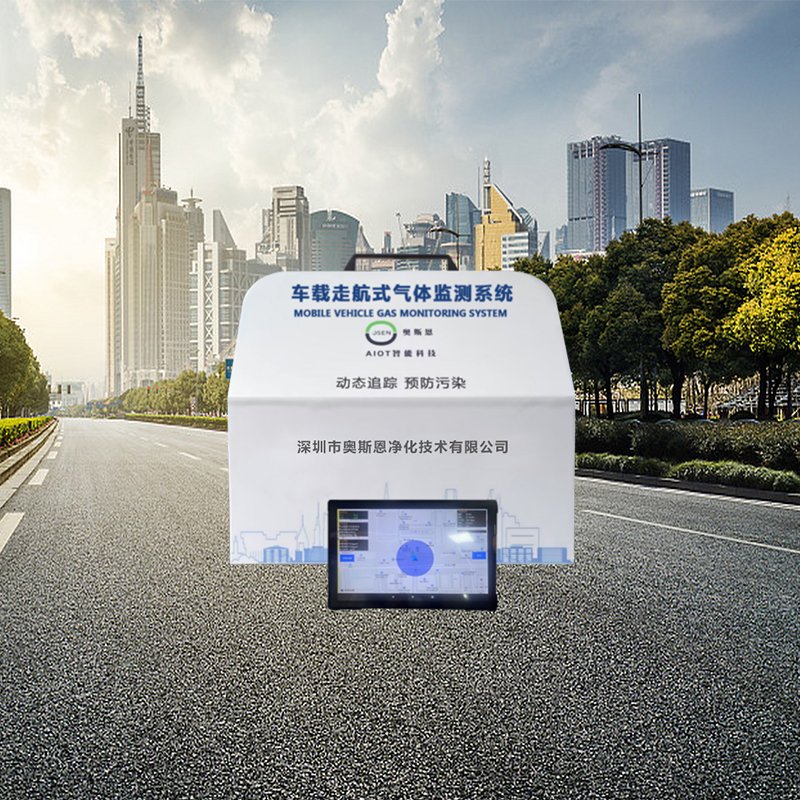
System Features
Ultra high maneuverability, full coverage without blind spots
By being mounted on dedicated mobile monitoring vehicles, it can flexibly shuttle through various scenarios such as urban roads, industrial parks, and suburban areas, breaking through the limitations of fixed station locations, achieving seamless coverage monitoring throughout the entire area, and quickly filling in and filling in monitoring blind spots. It is particularly suitable for dynamic monitoring of dispersed and mobile pollution sources.
Real time response fast, data updates in seconds
The response time of the core monitoring module is ≤ 1 second. The monitoring data is collected in seconds and uploaded in minutes, which can reflect the trend of regional pollution concentration changes in real time. When pollutants exceed the standard, on-site warnings can be triggered immediately. Compared with hourly data updates at fixed stations, it greatly improves response efficiency and saves valuable time for emergency response.
High monitoring accuracy, authentic and reliable data
Adopting industrial grade high-precision sensors with a monitoring error of ≤± 2% FS, it has automatic calibration and zero drift correction functions, and is equipped with multiple filtering devices to effectively resist environmental interference such as dust, humidity, and temperature, ensuring the authenticity and reliability of monitoring data and meeting national environmental monitoring data quality requirements.
Multi parameter integration, one-stop monitoring
It can simultaneously monitor the concentrations of various key atmospheric pollutants, including methane, ethane, carbon monoxide, carbon dioxide, sulfur dioxide, nitrogen dioxide, nitrous oxide, odorous gases, VOCs, etc., without the need for separate monitoring equipment, achieving "one-stop" comprehensive monitoring, meeting the multidimensional monitoring needs of different scenarios, and reducing monitoring costs.
Accurate traceability, supporting scientific control
By combining GPS positioning technology and intelligent analysis algorithms, it is possible to accurately locate the points of pollution concentration exceeding the standard, draw a thermal map of pollution concentration, analyze the diffusion path and source of pollution, distinguish the contribution of different pollution sources, provide accurate basis for pollution control and responsibility definition, and solve the pain point of difficult traceability of fixed stations.
On site warning, timely and efficient disposal
Equipped with a vehicle mounted terminal warning interface, when the concentration of pollutants exceeds the standard, the over limit warning mechanism can be immediately triggered and displayed on the navigation trajectory through color differentiation. At the same time, the warning information is pushed to the navigation supervision platform and relevant personnel, achieving a dual reminder of "on-site warning+remote push" to ensure timely detection and rapid disposal of pollution problems.
3 data linkage, forming a closed-loop control system
Navigation monitoring data can be seamlessly linked with regulatory platforms, enforcement terminals, and corporate governance systems. The data can be directly used for enforcement evidence collection, corporate pollution assessment, and environmental quality analysis, building a complete control loop of "monitoring analysis warning disposal feedback" and fully realizing the value of data.
Keyword: